Industry Report Q1 2026





Executive Summary
Q1 2026 showed a diamond market that was under pressure, but not in one uniform way. Globally, natural prices moved lower in a measured and relatively controlled way, with smaller Round goods holding up better than Fancies and larger sizes showing far more stability than the categories below them. From late February through the end of the quarter, geopolitical tensions, including conflict involving the US, Israel, and Iran, created disruptions across financial and trading markets. This had a direct impact on the diamond trade, particularly in key hubs such as Israel and Dubai, where tradability became more challenging and market activity was affected. The sharper weakness appeared in the United States, where changing tariff expectations through February created a more hesitant buying environment just as more goods were becoming available locally. Prices stabilized again once the market had more clarity, but the quarter made clear that uncertainty itself can be enough to weaken pricing support.
One of the clearest patterns in the quarter was the growing split between smaller US goods and the broader global market. Outside the US, tighter supply helped smaller natural Rounds remain relatively steady, preventing sharper price declines. In the US, however, smaller goods were more exposed, with rising availability and shifting expectations putting more immediate pressure on prices. At the same time, Fancies remained the weaker side of the natural market, showing broader declines than Rounds and reinforcing how selective demand became during the quarter.
Higher up the size curve, the market became noticeably steadier. Natural 2ct and 3ct goods remained broadly stable both globally and, in the US, showing that larger goods were less reactive to the uncertainty and repricing pressure affecting smaller categories.
Lab-Grown followed a different path entirely. Rather than showing selective pockets of stability, Lab-Grown prices continued to move lower in a more direct way, with competitive pressure and expanding availability continuing to drive price erosion.
For buyers and suppliers alike, Q1 2026 reinforced the importance of understanding not just what category you are trading, but where it is located, how much comparable inventory is available, and how confidently the market is willing to absorb it.
Overview of the Industry
Natural Indexes
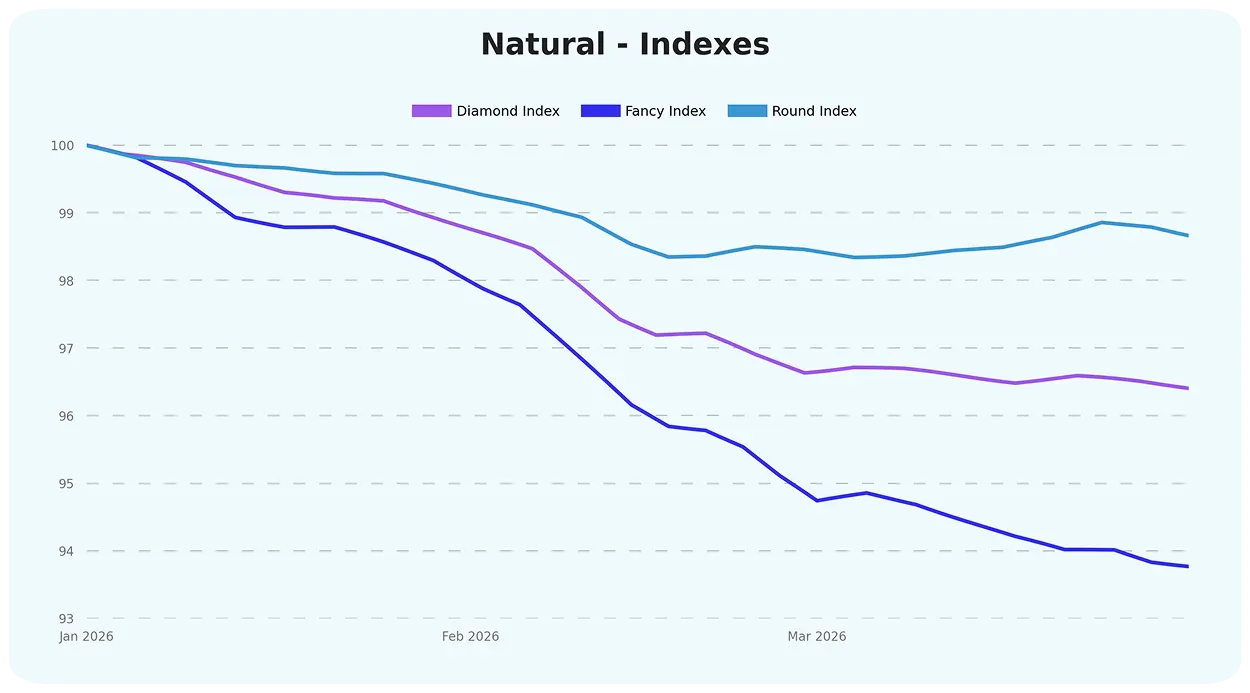
The natural diamond market weakened in Q1 2026, with the Diamond Index decreasing by 3.6% over the quarter. The decline was steady rather than abrupt, showing continued pressure on the market as prices softened across categories. Compared with the sharper resets seen in earlier tariff-driven periods, the quarter was more controlled, with pricing moving lower in a more measured way.
Within that, Rounds remained the most stable category, with the Round Index down just 1.3% over the quarter, while the Fancy Index fell by 6.2%. This gap shows that most of the pressure in the natural market was concentrated in fancies rather than rounds. While the broader market moved lower overall, rounds held relatively steady, while fancies saw more meaningful price corrections and pulled down the wider natural index.
Natural US Indexes
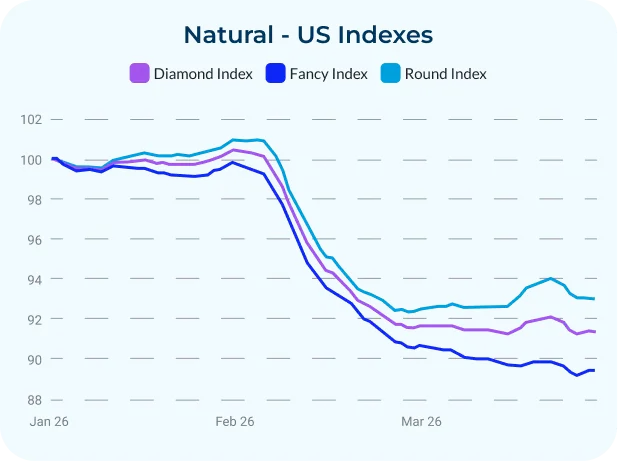
US-based natural inventory saw sharper price decreased than the global market in Q1 2026. The US Diamond Index declined by 8.5% over the quarter, with the US Round Index down 6.9% and the US Fancy Index down 10.4%. Most of these decreases took place during February, making that month the clearest turning point in the quarter.
This pricing move coincided with tariffs dropping to 10% from the higher tariff previously applied to Indian goods, alongside constant rumors throughout February that tariffs might be removed completely. That combination created a period of adjustment and uncertainty, which translated into sharper downward price movement in US-based inventory. Once those rumors faded and the tariff level settled at 10%, prices stabilized again and the pace of decline eased into the end of the quarter.
Lab-Grown Indexes
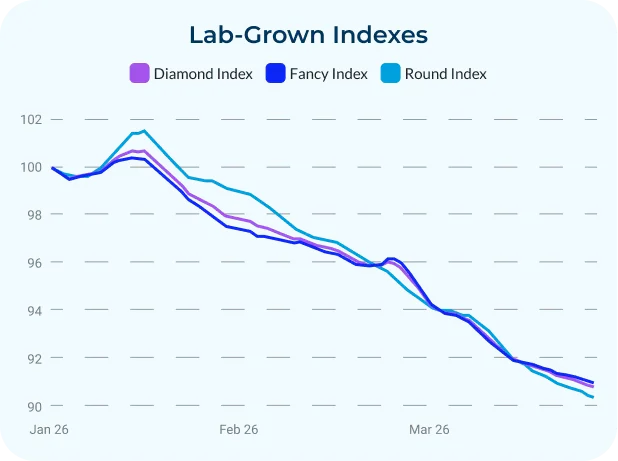
The Lab-Grown market also came under pressure in Q1 2026, with the Lab-Grown Diamond Index decreasing by 9.3% over the quarter. The Lab-Grown Round Index fell by 9.7%, while the Lab-Grown Fancy Index declined by 9.1%. Unlike naturals, where the pressure was more uneven between rounds and fancies, Lab-Grown prices moved down in a much more uniform way.
Rounds and Fancies by Size Group
Natural 0.30ct and 0.50ct
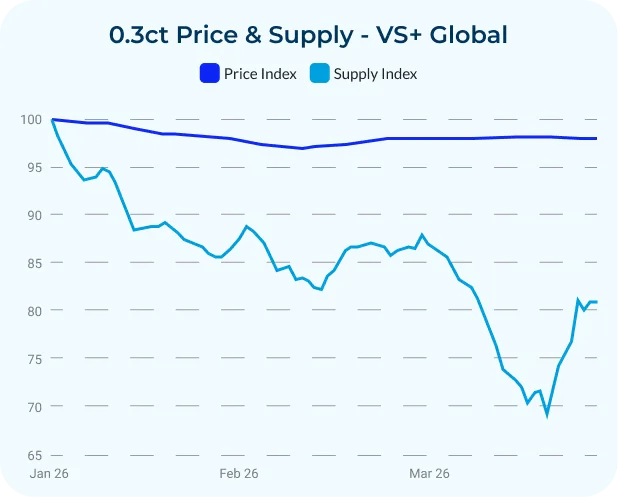
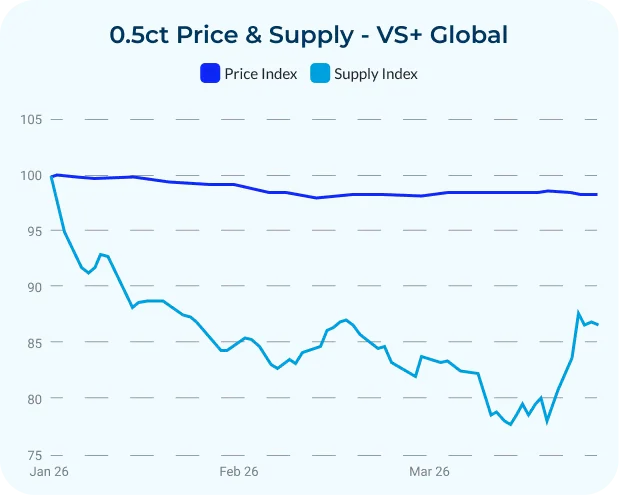
Natural Round 0.30ct and 0.50ct VS+ diamonds followed a similar global pattern in Q1 2026. In both size groups, prices remained relatively stable, with 0.30ct down just 2% and 0.50ct down 1.5%, while supply declined by 19% and 13% respectively. This suggests that outside the US, tighter availability helped offset softer demand and kept smaller Round goods from seeing a sharper correction. Rather than losing support all at once, both categories remained relatively balanced through the quarter. That said, after the quarter ended, April price list reductions created renewed pressure on these sizes, suggesting that the relative stability seen in Q1 may not have held into the following month.
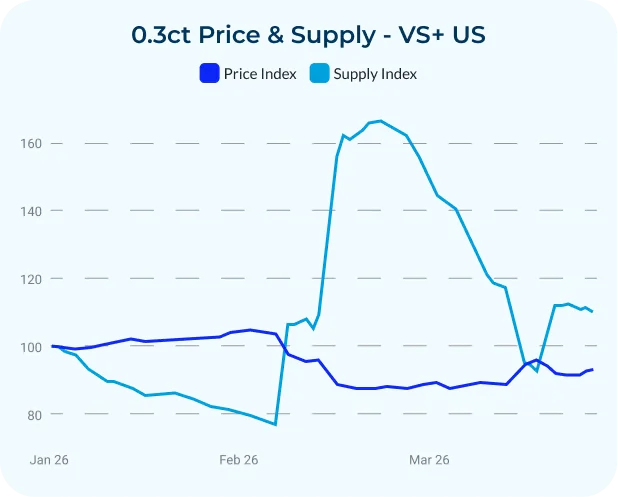
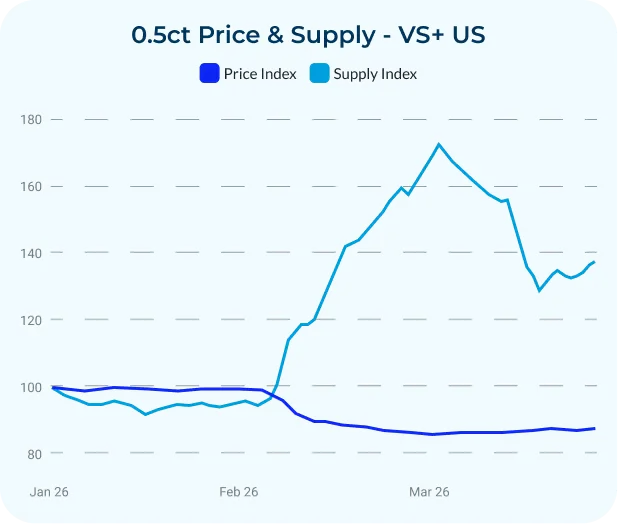
The US picture was weaker in both sizes, but the pressure was more pronounced in 0.50cts. For VS+ diamonds located in the US, 0.30ct prices decreased by 7% while supply increased by 10%, whereas 0.50ct prices fell by 12% as supply rose by 37%. In both cases, most of the weakness was concentrated in February, when tariff expectations were shifting and buyers were more hesitant. The sharper move in 0.50cts suggests that once more inventory entered the US market, pricing became more exposed, with the larger supply increase translating more directly into lower prices. In both 0.30ct and 0.50ct Fancies, pricing pressure was broad, with price decreases seen across the quarter, reinforcing that smaller Fancy goods remained under more pressure than Rounds.
Natural 1ct
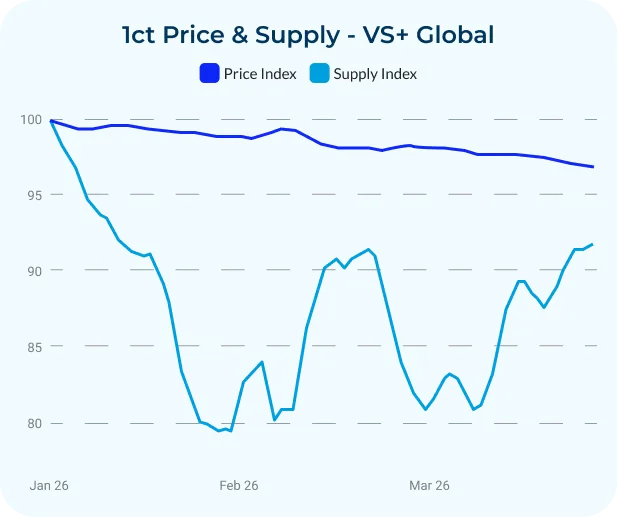
Natural Round 1ct VS+ diamond prices decreased by 3% in Q1 2026, with pricing moving gradually lower throughout the quarter. Supply also declined, falling by 8% overall. Compared with the smaller size groups, 1ct Rounds still saw a controlled market, but unlike 0.30ct and 0.50ct goods, the quarter showed a clearer steady downward price trend rather than near-flat stability. That suggests the 1ct segment was not under sudden pressure, but was instead repricing more gradually as the quarter progressed. Even with supply moving lower, that decline was not enough to fully offset softer pricing, which points to demand easing more noticeably in this size group than in the smaller Rounds.
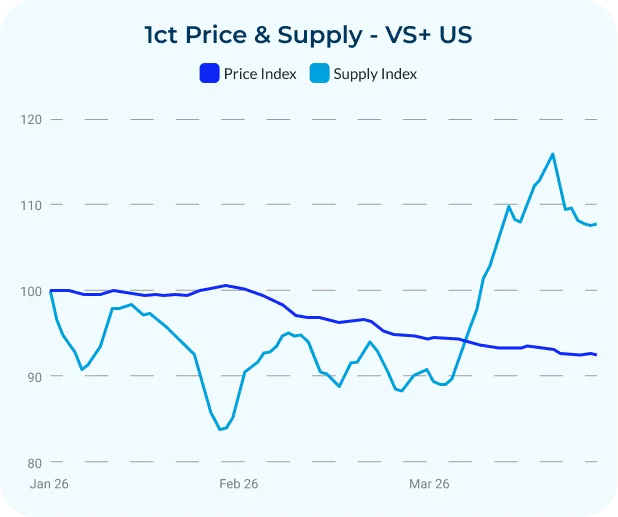
The US picture was weaker. For VS+ diamonds located in the US, prices decreased by 8% while supply increased by 8%. From February through the end of the quarter, prices moved lower, showing more sustained pressure in the US market than globally. The increase in availability, together with the broader tariff-related adjustment in the market, put more weight on US pricing across the back half of the quarter. Unlike the February-led reset seen in smaller categories, the pressure in US 1cts was more prolonged, which suggests buyers remained cautious for longer in this size group. That makes 1ct goods look less like a short-term adjustment and more like a category that lost pricing support steadily as the quarter went on.
Natural 2ct
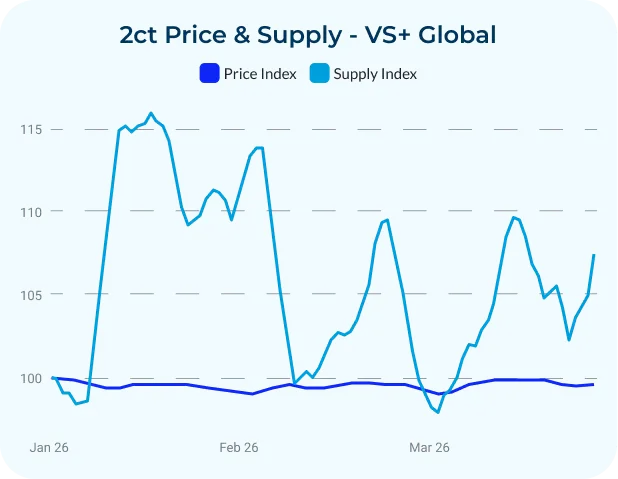
Natural Round 2ct VS+ diamond prices remained stable in Q1 2026, decreasing by just 0.4% over the quarter. Supply was more volatile than price, moving up and down throughout the quarter before ending Q1 up 7%. The segment absorbed changing availability without meaningful repricing, pointing to a market that remained balanced even as inventory levels shifted. That stability suggests demand in 2ct goods stayed firm enough to absorb supply changes without creating real downward pressure on prices. Rather than reacting sharply to short-term shifts in availability, this segment appears to have held its pricing base throughout the quarter.
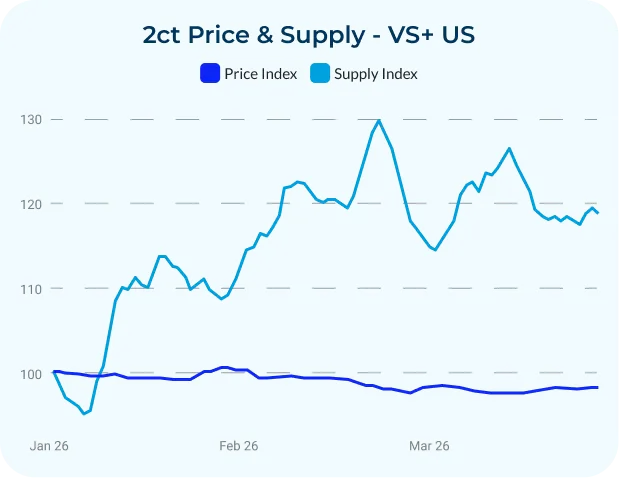
For VS+ diamonds located in the US, prices decreased by 2% while supply increased by 19%. Prices stayed relatively steady overall, even as availability moved higher, suggesting that US-based 2ct goods were able to absorb the increase in supply without a sharp reset. This points to a US 2ct market that remained broadly stable through the quarter, even with a meaningful rise in supply. That is especially notable given the broader tariff backdrop, because it shows 2ct goods were less sensitive to the pressure that weighed more heavily on smaller sizes. In other words, even with more inventory entering the US market, buyers still supported pricing well enough to keep the segment relatively steady.
Lab-Grown 2ct
Lab-Grown 2ct Rounds followed a very different path in Q1 2026. Prices declined by 16% over the quarter, while supply rose by 190%, creating clear and sustained pressure on pricing. Availability expanded sharply through the quarter, and prices moved lower as the market absorbed that growing volume.
The contrast with Natural 2ct goods is clear. While Natural 2ct prices remained broadly stable, Lab-Grown 2ct saw rising supply translate directly into lower prices. This reinforces the broader Lab-Grown pattern, where growing availability and intense competition continue to drive price erosion more quickly than in the natural market.
Natural 3ct
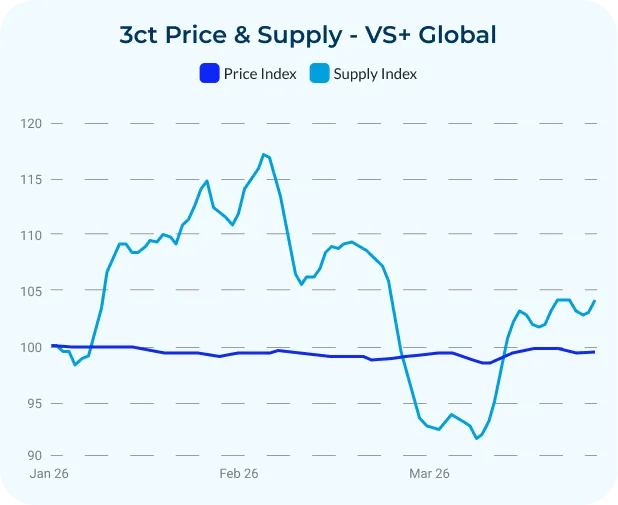
Natural Round 3ct VS+ diamond prices remained stable in Q1 2026, decreasing by just 0.6% over the quarter. Pricing stayed in a very narrow range throughout Q1, showing that the segment remained broadly balanced with little meaningful movement over the period. This suggests 3ct goods continued to hold their price position well, with the market showing little sign of forced repricing despite the broader uncertainty in natural diamonds. Rather than drifting lower through the quarter, the segment stayed anchored, pointing to continued stability at the larger end of the market.
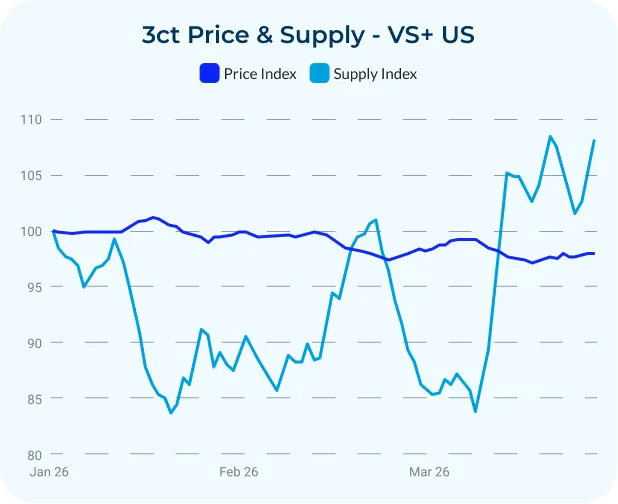
The US market showed a similar pattern. For VS+ diamonds located in the US, prices decreased by 2% over the quarter. Despite some movement during Q1, pricing remained relatively steady overall, suggesting that US-based 3ct goods also avoided any sharp reset through the quarter. That relative stability suggests buyers remained willing to support pricing in this size, even in the US market where other categories saw more visible pressure. Taken together, global and US 3ct performance points to a segment that stayed resilient and largely insulated from the sharper adjustments seen elsewhere.
Lab-Grown 3ct
Lab-Grown 3ct Rounds followed a different path in Q1 2026. Prices declined by 15% over the quarter. Unlike Natural 3ct goods, which remained largely stable, Lab-Grown 3ct continued to see clearer downward pressure, reinforcing the broader pattern of faster price erosion across the Lab-Grown market.
Key Insights
Smaller US goods saw more price pressure as availability increased
Q1 suggests that smaller US goods became a softer part of the market, creating more room to negotiate as pricing came under more pressure once availability increased. Rather than assuming US-located smaller diamonds justified firmer pricing simply because they were already stateside, it made more sense to compare prices more carefully and push harder where availability was rising. The opportunity was in finding better value in categories where pricing was under more pressure, while staying disciplined on what price still made sense to pay.
Larger Natural goods remained a steady place to buy and hold
Q1 showed that 2ct and 3ct Natural goods remained one of the steadiest parts of the market. Prices stayed supported through the quarter, which made these categories feel safer both to hold in inventory and to buy when needed. The market did not show signs of meaningful pressure in these sizes, which gave more confidence that the price being paid still made sense and was being supported by real demand. In a quarter where confidence mattered, larger Naturals stood out as one of the clearest areas of stability.
1ct Naturals saw steady price erosion through the quarter
Q1 showed that 1ct Naturals did not weaken through one sharp reset, but through a steady decline across the quarter. That made turnover more important to protecting margin, because holding these goods for too long created more risk that they would be worth less by the time they sold. In this kind of market, it became more important to buy when needed, stay disciplined on price, and avoid sitting on inventory longer than necessary.
Lab-Grown remained a market where prices kept moving down
Q1 showed that Lab-Grown remained under ongoing price pressure, which made it harder, like in 2025, to retain margins through the quarter. In this kind of market, it became more important not to sit on inventory, especially when availability remained high and there was plenty of choice. The opportunity was simply to buy when needed, stay disciplined on price, and fight for every dollar.
Conclusion
Q1 2026 showed a Natural diamond market that was under pressure, but not evenly. Globally, prices moved lower in a measured way, with smaller Round goods holding relatively steady while Fancies faced broader weakness. In the US, pricing came under more pressure, especially in smaller sizes, where rising availability and shifting tariff expectations created more pressure on pricing through February and into the back half of the quarter. The result was a market where location, shape, and size all played a clear role in how goods performed.
As the quarter moved into larger sizes, stability became much more visible. Natural 2ct and 3ct goods remained comparatively anchored, both globally and in the US, showing that not all parts of the market reacted the same way to uncertainty. Lab-Grown followed a different path entirely, with more direct and continued price erosion across larger goods as competition remained intense. Following the end of Q1, additional April price list reductions created renewed pressure on smaller goods, suggesting that the relative stability seen in those sizes during the quarter may not have carried forward. At the same time, geopolitical tensions and disruptions to trading activity in key centers such as Israel and Dubai continued to affect tradability and market liquidity, reinforcing how strongly external events shaped market behavior during the period. Overall, Q1 was less about a broad market reset and more about a market becoming increasingly selective, with pressure concentrated in specific categories while others continued to hold their ground.
Ready to Elevate Your Diamond Trading?
Leave your details to book a demo and one of our representatives will get back to you as soon as possible!
 Search Registrant Register List - Dealers in Precious Metals and Stones Registration System